The Glowing Bike Path in the Netherlands: How Van Gogh's Starry Night Was Laid Beneath Your Feet
Key Takeaways
- •The 600-meter Van Gogh-Roosegaarde bike path is embedded with 50,000 photoluminescent stones that glow for 8 to 10 hours after solar charging
- •Located in Nuenen, Van Gogh's hometown, it is part of the 335-kilometer Van Gogh cycling route and is free to visit 365 days a year
- •Part of the Smart Highway project, which conducted the world's first glowing highway trial on the N329 road in Oss, Netherlands, in 2012
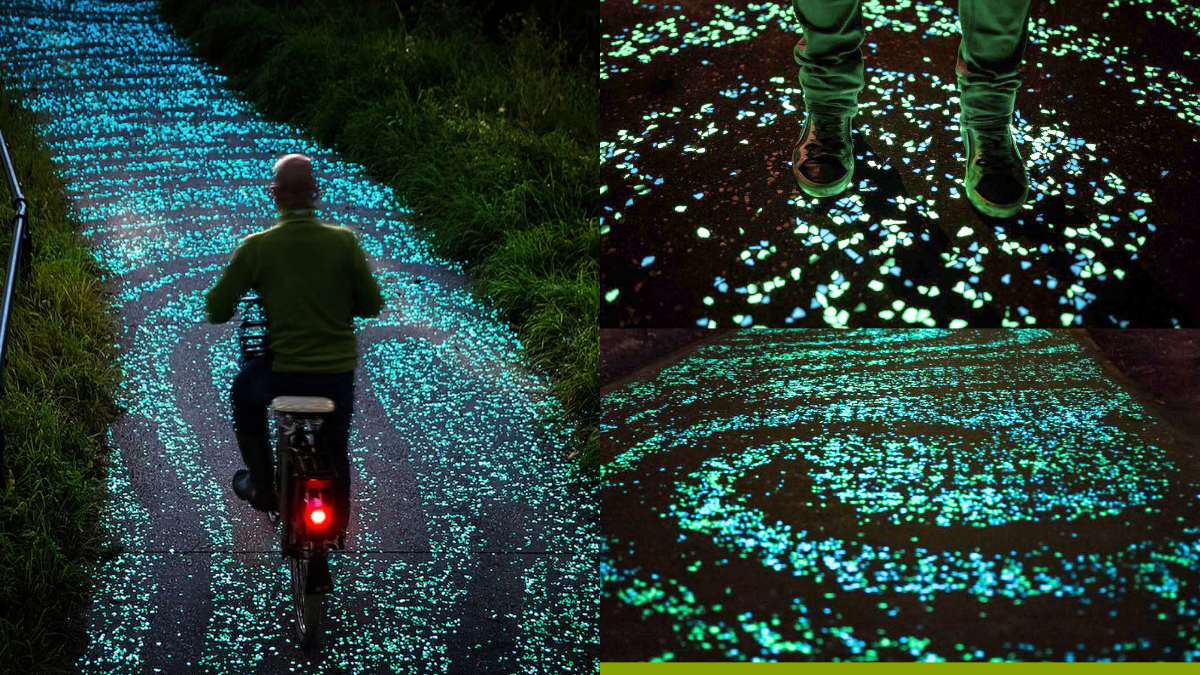
In southern Netherlands, between Eindhoven and Nuenen, there is a 600-meter-long bicycle path. During the day, it looks no different from any Dutch country road. But after nightfall, fifty thousand tiny stones on the road surface begin to emit blue-green light, painting swirls, curves, and flowing patterns in the darkness.
If you've ever seen Van Gogh's The Starry Night, you'd immediately recognize the source of these lights.
This path is called the Van Gogh-Roosegaarde bicycle path. It was officially opened on November 12, 2014, and remains the only "self-illuminating" bicycle path in the world to this day.
Fifty Thousand Breathing Stones
The core technology of this path is called photoluminescence. The road surface is embedded with approximately fifty thousand stones treated with a special coating. During the day, the coating absorbs energy from sunlight. At night, the stones begin to glow softly, painting Van Gogh-style swirl patterns on the road.
According to official data from Studio Roosegaarde, these stones can continue to glow for 8 to 10 hours after a full day of charging. Even in the Netherlands' cloudy and rainy weather conditions, the stones can still store enough energy for nighttime illumination.
Designer Daan Roosegaarde described the nighttime experience as "going through a fairy tale" in an interview with NPR. But this fairy tale is not about nostalgia. It's about how a 19th-century painting can solve a 21st-century problem: making nighttime cycling safer.
Why Here: Van Gogh's Birthplace
The location of this bicycle path was not chosen at random. Nuenen is located in the province of North Brabant in the Netherlands. Van Gogh was born in 1853 in nearby Zundert and spent a crucial period of his creative career in Nuenen, completing over 180 works including the masterpiece The Potato Eaters.
2014 happened to be the year before the 125th anniversary of Van Gogh's death. The Dutch government designated 2015 as "Van Gogh Year" (Van Gogh 2015), and the Van Gogh-Roosegaarde bicycle path was one of the earliest projects in this commemoration series.
Roosegaarde said in an interview with Dezeen that his goal was not to "replicate" The Starry Night, but to "bring Van Gogh's energy back to his hometown." The swirl patterns on the road surface are an "interpretation" rather than a copy, inspired by the spiral forms in Van Gogh's painting.
It Wasn't Actually the First: The Smart Highway Project
Many people think the Van Gogh Path was a spontaneous idea from Roosegaarde. It wasn't. It was part of a larger plan.
In 2012, Roosegaarde presented the "Smart Highway" concept at Dutch Design Week, proposing the use of luminescent paint to replace traditional street lights. The first test section was a 500-meter stretch of the N329 highway in Oss, using glow-in-the-dark lane markings.
The Smart Highway concept won the 2013 INDEX Design Award and the Dutch Design Award for "Best Future Concept." The Van Gogh Path was the second physical realization of this project, but it added a key variable: speed. Highway cars travel at 100 km/h; cyclists move at 15 km/h. The difference in speed changes everything.
The difference in speed changed everything. The same technology that serves as a safety feature on highways became an artistic experience on a bicycle path.
Free, Open, No Barriers
The Van Gogh-Roosegaarde bicycle path is a completely free public facility. There is no admission fee, no restricted opening hours, and it is open to everyone 24 hours a day, 365 days a year. The starting point is at the Vincent van GoghHuis museum in Nuenen, and the path is directly connected to the town's existing bicycle network.
This 600-meter glowing section is embedded within a much larger route: the 335-kilometer-long Van Gogh Cycle Route, which connects all the places where Van Gogh lived in the province of Brabant, including his birthplace in Zundert, his creative base in Nuenen, and the church in Etten-Leur.
For the local economy of the Netherlands, the value of this path lies not in ticket revenue, but in the fact that it created a "nighttime destination." Travelers who would normally only spend a daytime in Eindhoven before leaving now have a reason to stay until evening. A road that charges nothing brought more overnight accommodation revenue to the surrounding area than many paid attractions.
An Experiment in "Practical Beauty"
In the ten years since the Van Gogh Path was opened, it has been covered by countless media outlets including CNN, NPR, Dezeen, and Atlas Obscura, and has been called "the most widely reported bicycle path in the world." But its truly important legacy is not fame.
In most cities around the world, the solution to "making nighttime cycling safer" is street lights. Street lights require power grids, electricity, and maintenance. Roosegaarde's luminescent road surface is completely self-sufficient, consuming no external energy. It proves that sustainability and beauty can be the same thing.
The most profound insight from this path may be this: while most cities are still debating how many sensors and cameras a "smart city" should install, Roosegaarde built a road that doesn't need any electronic devices, using only stones and sunlight to create an experience that is simultaneously safe, beautiful, and free.
Sometimes, the smartest technology is not the most complex technology. It's the kind that makes you forget technology exists.


